'Yes I can': Rancho Mirage artist's work joins the likes of Picasso at Athens museum
By Ema Sasic
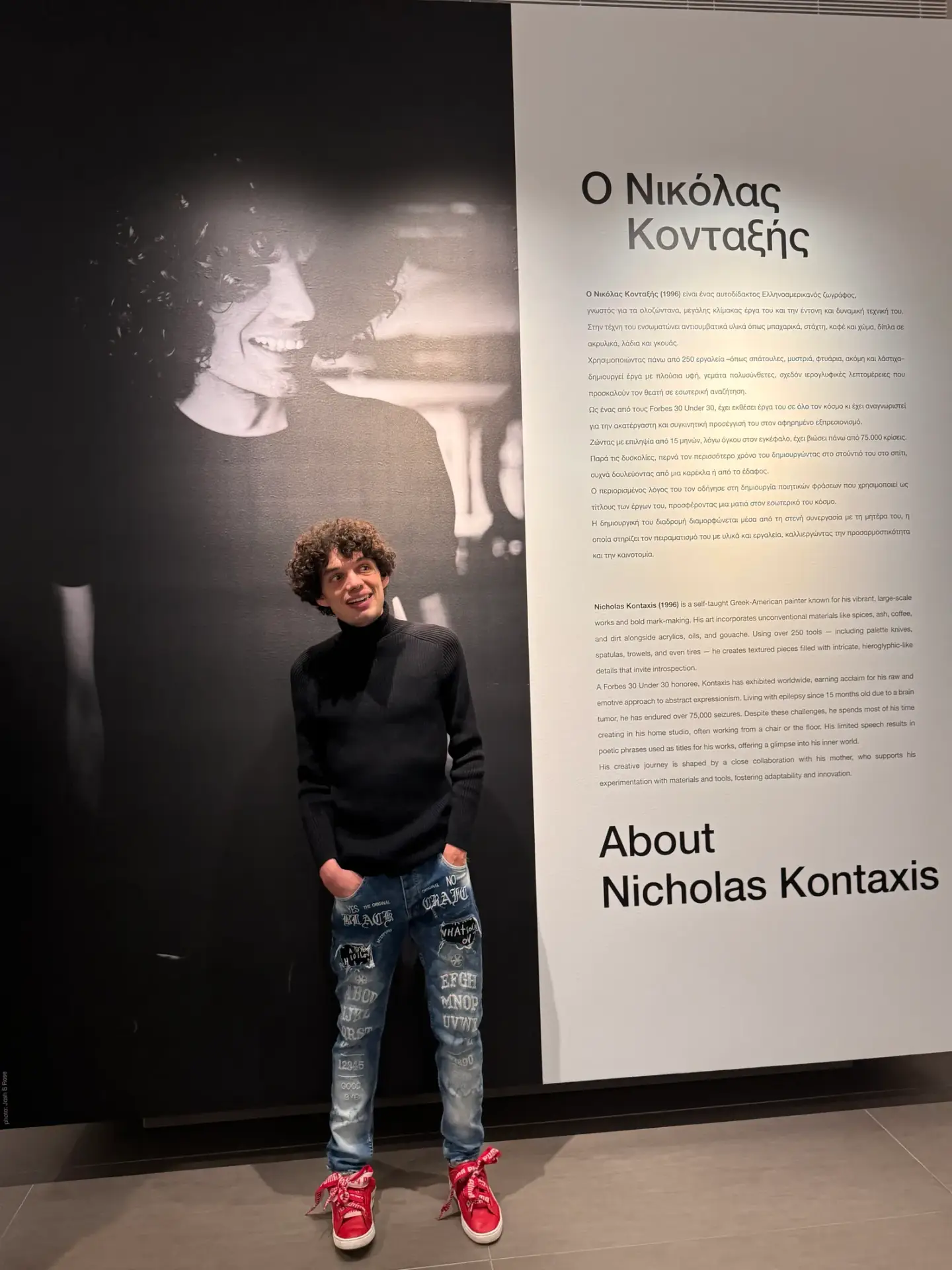
Greek-American artist and Rancho Mirage resident Nicholas Kontaxis poses in front of his exhibit, "Catch Me," at the Basil & Elise Goulandris Museum in Athens, Greece
Nicholas Kontaxis isn’t able to explain verbally what a brush stroke means or why he uses certain tools, but the artist’s work conveys a strong message of overcoming obstacles and creating something meaningful in the process.
It’s “more feel than form,” Krisann Kontaxis, his mother and studio representative, explained.
The Rancho Mirage artist was diagnosed with a brain tumor at 15 months, which has led to thousands of seizures, autism and developmental delays. Nicholas began painting at age 14, and though his seizure disorder limits his ability to speak, he largely communicates through his work, which has captured the hearts of people all around the world.
Nicholas, who is Greek-American, has shown work in several international galleries. But his latest show, “Catch Me,” exhibiting at the Basil & Elise Goulandris Museum in Athens, Greece, has come with exciting firsts and important reminders for those who view it. The show embodies Nicholas’ resilience and the universal need for support during life’s struggles. The exhibit is on display through May 18.
Safety net has symbolic meaning in 'Catch Me'
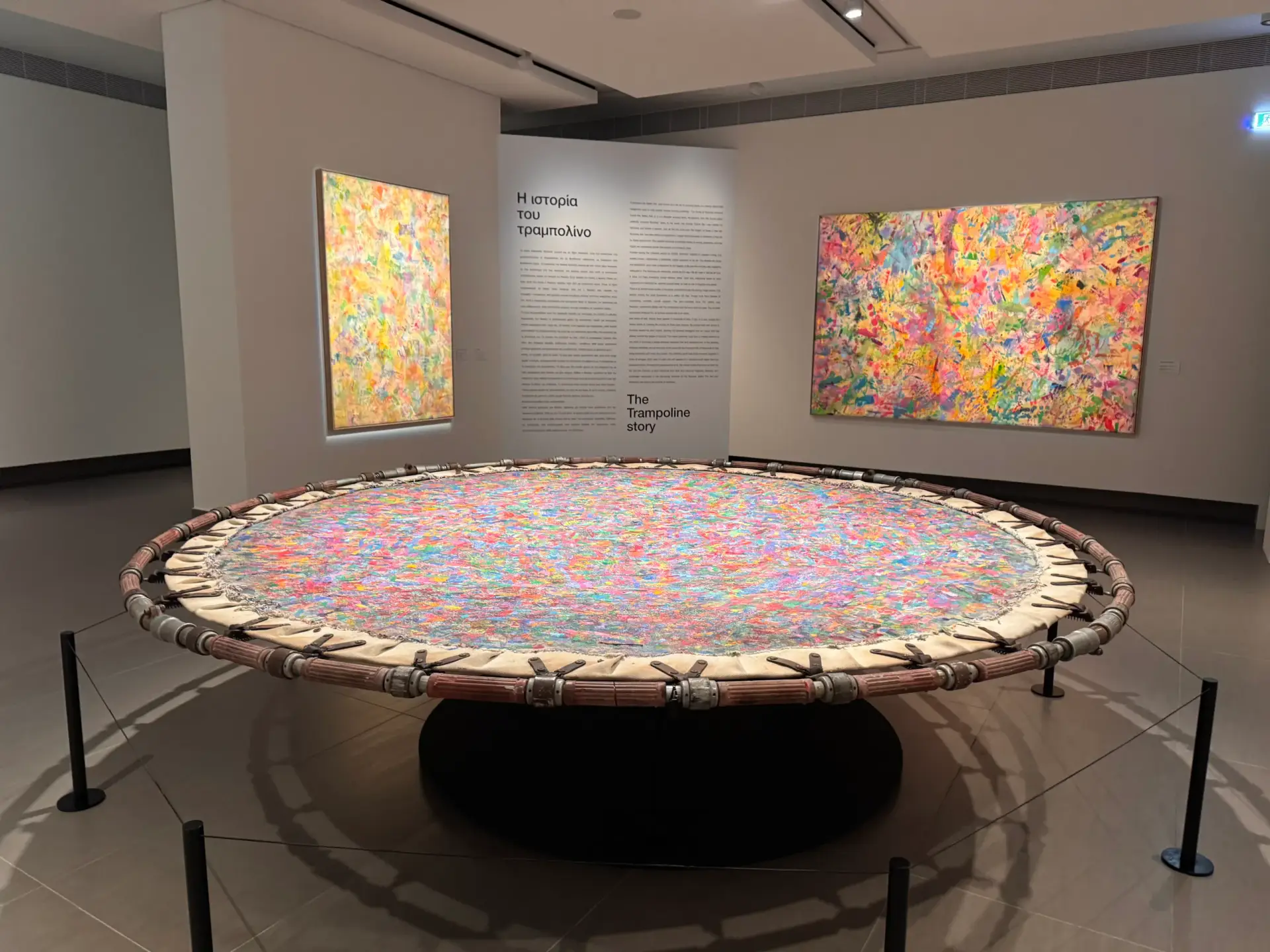
The centerpiece of “Catch Me” is a colorful, symbolic trampoline that has been reimagined as a canvas.
The Browder Life Safety Net, also known as a life net or jumping sheet, is a rescue device that was used by firefighters to help catch people from burning buildings. The net was patented in 1887 and was in use until the 1980s, when firefighting technology advanced.
Krisann explained she found the net in a salvage shop in downtown Los Angeles and quickly found a deep correlation to her son’s story.
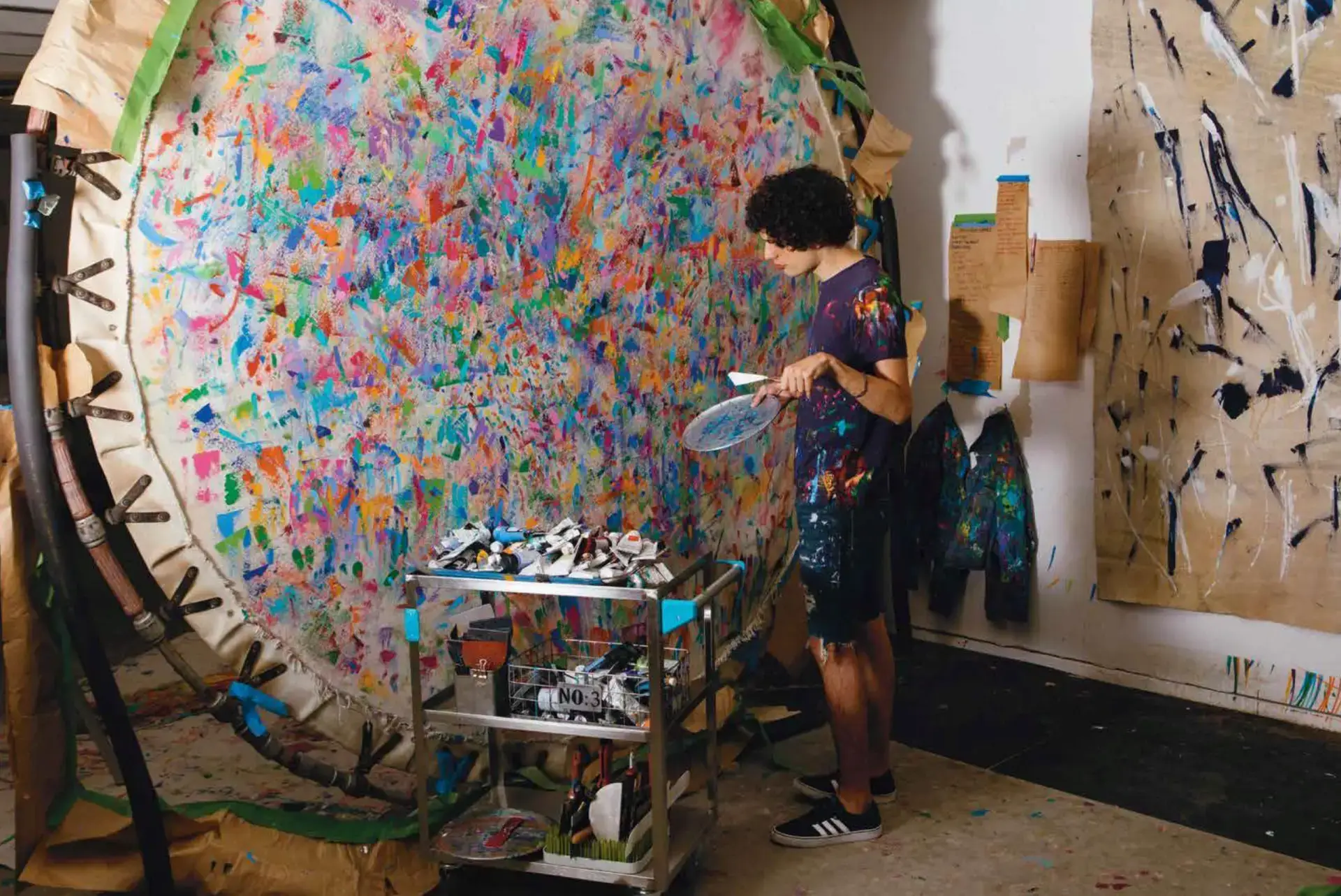
Nicholas Kontaxis works on "Catch Me" in his studio in Rancho Mirage.
“We, too, have caught Nicholas many times, and so the theme in that net really told our story concisely,” she said. In his youth, Nicholas would often utter the words “Catch me” just before a seizure.
Working on the piece during the height of the COVID-19 pandemic, Krisann said it took Nicholas about eight months to paint it. Depending on his condition, he’ll either paint from a chair or lying down on the ground when days are difficult, further demonstrating the symbolic meaning of the piece.
The large canvas features thousands of markings on it, which she said are all deliberate. Each marking can be interpreted as the number of times Nicholas’ family has had to catch him when he has experienced a seizure, and be a representation of the words, “I’ve made it.” As an ode to the firefighters who saved people’s lives with the net, Nicholas also applied ash from his fireplace in between layers on the canvas.
The centerpiece of "Catch Me" is a colorful, symbolic trampoline that has been reimagined as a canvas
Since the exhibit opened, Krisann said the trampoline piece has been resonating with people and making them think about their relationships with themselves and others: “Do we catch each other? Do we catch ourselves when we need to give ourselves a break? How as a community can we truly, simply, catch each other instead of pushing each other away?”
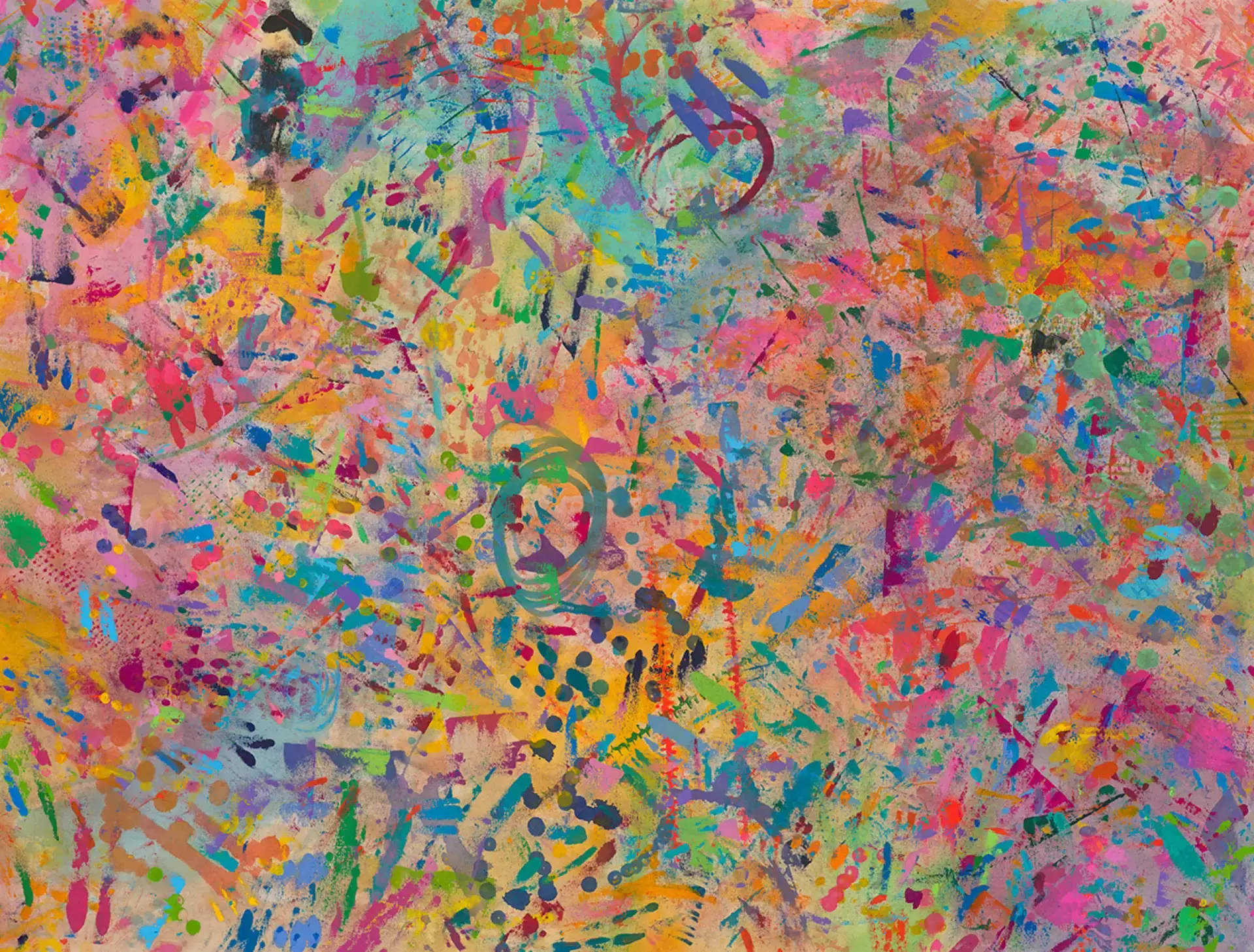
The exhibit also features a number of Nicholas’ other artwork, many of which feature a wide array of colors, circular shapes and an homage to his heritage. “YiayYia Is Here” is a colorful ode to his Greek grandmother, who helped raise him. There’s also “Spanakopita,” named after a savory traditional dish, which features hundreds of overlapping brush strokes, similar to the delicacy made of layers of feta, spinach and flaky phyllo dough.
To an unfamiliar passerby, it might seem like there’s no rhyme or reason why a painting is titled the way it is — some other artworks in the show are named “Passwords,” “Thomas Edison” and “My Clock Is Set.” But when Nicholas experiences moments of clarity, his phrases are recorded and used for the titles of his works.
Nicholas Kontaxis' painting "YiayYia Is Here"
“We find it important for his future and our knowing that these things are from his mouth,” Krisann said. “You never know, his speech could close down more even, so the archives are important.”
Ever since Nicholas began painting, Krisann said his practice has been built around how he’s feeling, both emotionally and physically. The Goulandris Museum is holding workshops for children to immerse themselves in Nicholas’ colorful world and encourage them to express themselves through whatever medium best suits them, both on their good and bad days.
There are also mindfulness events and games for people age 60 and older and those with mild cognitive impairment taking place in collaboration with Nicholas’ art. Paintings are also accessible to those who are deaf, blind or need to utilize a wheelchair.
“The beautiful thing is, he’s found a way to push the frequencies out of the way and to access. That’s important for all of us,” Krisann said. “We need to push away what bothers us, push away what hooks us … and we can’t get off, and overcome and still try and access each other, writing, our jobs, and not always expect to feel perfect. In imperfection could be something very, very special.”
Lighting up the Greek sky
The family’s time in Greece has been filled with warm welcomes and historic moments.
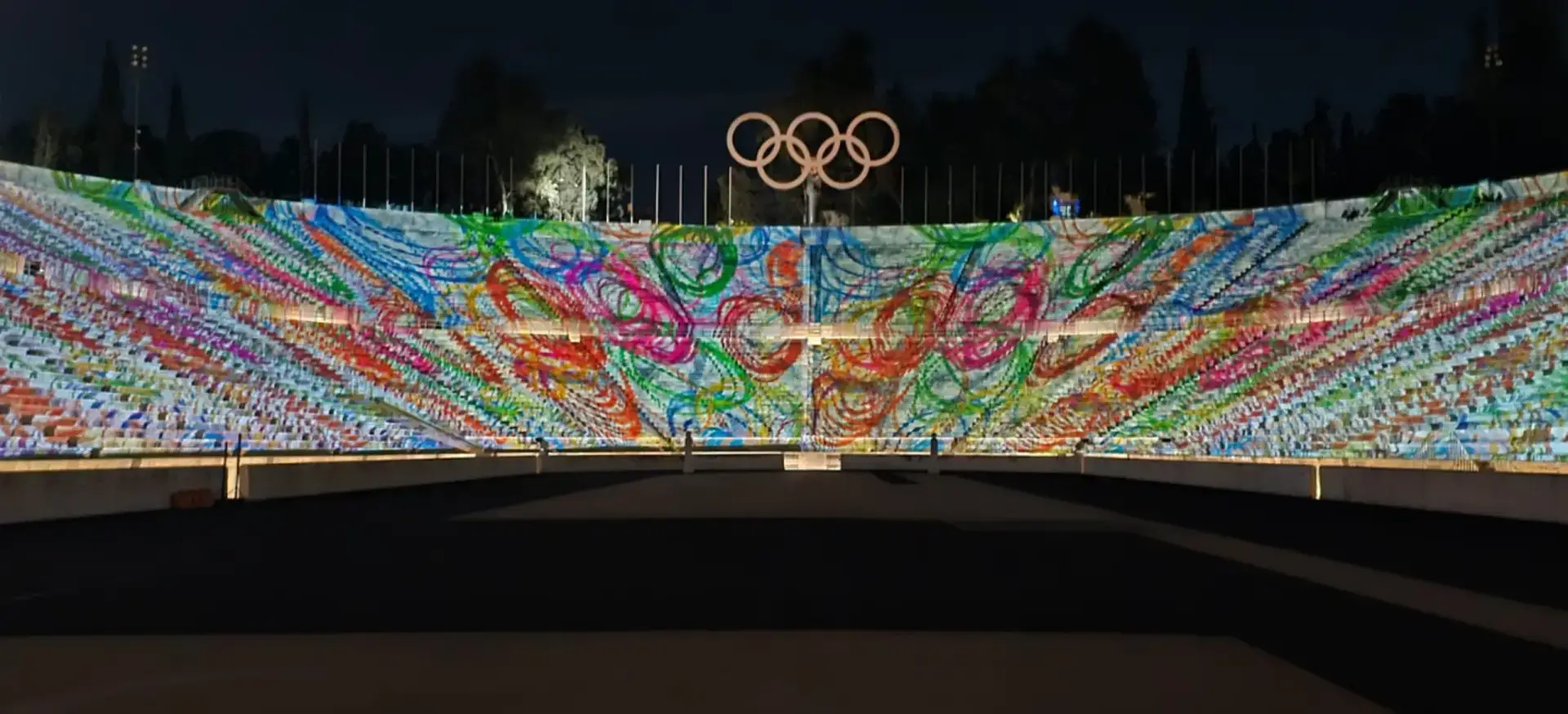
Before the museum exhibit opened, a large-scale projection of Nicholas’ “Yes I Can” artwork was projected onto the Panathenaic Stadium, where the first modern Olympic Games in 1896 were held. Ironically, “Yes I Can” features several drawn circles, which complements the Olympic logo of five interlaced rings.
A large-scale projection of Nicholas Kontaxis' "Yes I Can" artwork was projected onto the Panathenaic Stadium in March
The projection marked the first time that the stadium, which was constructed in the 4th century B.C., was illuminated into a canvas of art. Nine antiquity and rarities committees had to sign off on it, Krisann said.
It was an “incredible” moment for him and his family, she said, which stood for “full inclusivity, overcoming obstacles and saying ‘yes I can’ instead of ‘no I can’t.'”
“I’m more in awe of the whole situation,” his mother added. “I’m just as amazed as this person that’s standing next to me because the over-swelling of people is so much.”
To make Nicholas feel at home in the exhibit, his studio has been recreated, and music that he listens to plays in the space. Krisann said he “must have done a double take 20 times” when he saw the area. One of Nicholas’ art pieces, “Let’s Make It Beautiful,” has also been acquired by the Goulandris. He joins a vast and impressive collection of artists in the museum, including Pablo Picasso, Vincent van Gogh, Claude Monet and Jackson Pollock.
An old safety net, like those once used by firefighters to catch people jumping from burning buildings, became a canvas in Nikolas’s hands, and one of the centerpiece works in the exhibition. Photo by Taylor Sherril.
“It couldn’t be better. The fact that we’re coming back to our roots (in Greece) … it definitely feels like coming home,” Krisann said.