
QX Magazine - UK
Freedom of expression – the liberating artwork of Nicholas Kontaxis
By QX Team

Diagnosed with a brain tumour at 15 months, suffering 50,000 seizures to date, Kontaxis’ art isn’t just survival, it’s a celebration.
Express: to make known the opinions or feelings of (oneself). We are constantly expressing ourselves, from a mumbled “thank you” to the person who holds the lift, to awkward drawn-out conversations on fifth dates on whether the relationship is going anywhere. From the smallest gesture to the most lengthy philosophical pontification, expressing our inner thoughts and feelings is what we do as people. Many of us don’t think twice about how easy it is to, say, tell someone to shuffle over if they’re blocking the television, or letting the Deliveroo driver know that you didn’t order those six meat-feast pizzas. For others though, it’s not that simple.
Nicholas Kontaxis is an artist from the deserts of California who, despite being in his early twenties, has made quite the name for himself on the art scene in just a few short years, enjoying sell-out shows across the US. In September, he made his London debut with solo exhibition Reach at West Contemporary Art where his large-scale colourful abstract expressionist pieces garnered admiration across the board. As a person with limited speech and living with physical disabilities, day-to-day life isn’t easy for him. In spite of life’s persistent hurdles, it’s clear to see Kontaxis isn’t doing too bad for himself. In fact, he’s enjoying a career that many St Martin’s graduates could only dream of.
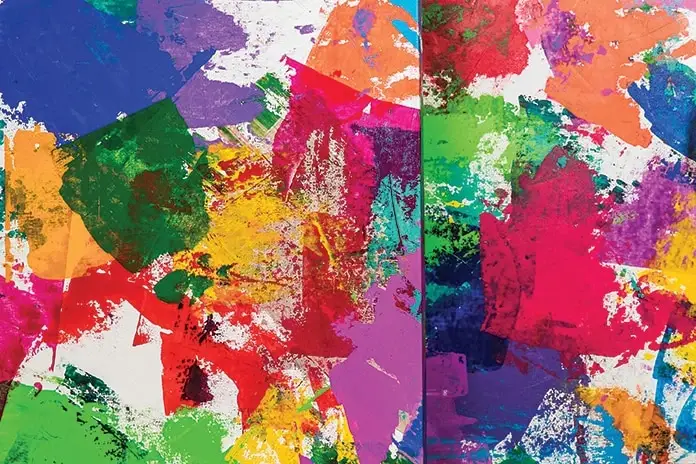
Things could have gone very differently for him in the days before he immersed himself in his art, Kontaxis’ mother Krisann told us. He had seemingly reached a dead-end when his high school’s disabled working program, because of his daily seizures, couldn’t offer him any opportunities. “We were worried he would never work in his life,” she recalls. “It was devastating for us.” Faced with the prospect of day after day being wasted, passing idle hours, which would’ve been detrimental to his condition, his parents decided to get creative. Remember that he had excelled in art in high school, they set up a studio for him in their garage. A few spare pots of paint, some white canvas, and a trusty palette knife. He was free to get to work.
“I remember that he used to put these rubber bands over nails, which helped with his movement,” his mother recalls, before sharing stories of Sunday mornings at church spent keeping him from caressing his fingers in a stranger’s brightly-coloured blouse. It seems as if the signs were all there; now all that was to do was to put paint to canvas. Having sold a few pieces to a couple of non-family members, the school district allowed him to pursue his soon-to-be burgeoning career as a visual artist. In the privacy of his garage-cum-studio, he was free to relish in those bright colours and send them splattering across a white canvas.