
Elculture - Greece
At the press conference for the exhibition—a tribute to the power of human will, and inclusion—at the Basil & Elise Goulandris Foundation
By Pepi Nikolopoulou
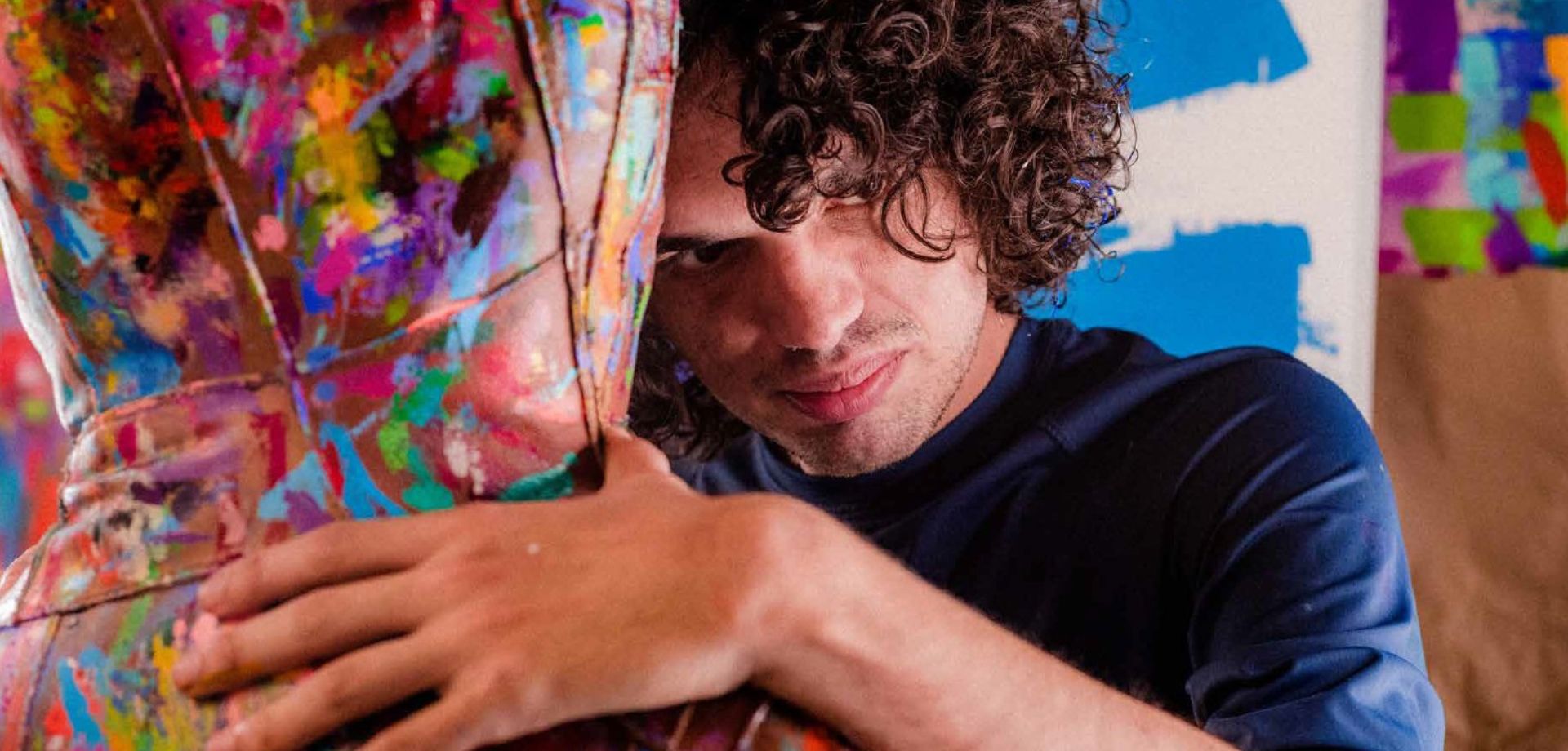
A little dancer glides across the ice, tracing vibrant circles with her skates, in tune with the music of her mind. Vivid colors weave a tale of joy, hope, optimism, healing, and courage. The compositions of Nicholas Kontaxis reveal nothing of the secrets of his journey, of the hardships that have stood, seemingly insurmountable, in his path for nearly three decades.
Living with severe physical and developmental challenges and having endured more than 75,000 epileptic seizures, Nicholas Kontaxis found, in his darkest hours, when words abandoned him and silence prevailed, a color for joy and hope. A paintbrush—like a long-lost friend—returned the words that had left him. A deep blue. A dazzling orange. A tender pink. This was his voice. Then came the red, the green, the yellow. The colors swirled, blended, and burst onto the canvas as if the words he could no longer say were being reborn through paint. And in those moments, he felt whole again. Because even when he couldn’t speak how he felt, he could paint it. And somehow, the world listened.
Art, his only tool of expression, and its transformative power carry a universal message of resilience and inspiration. The exhibition “Catch Me” brings to Greece, for the first time, the work and life story of Nicholas Kontaxis, the internationally acclaimed Greek-American artist and Forbes 30 Under 30 honoree, who has transformed the challenges of his life into an explosive artistic language brimming with strength, emotion, and optimism.
“Nicholas’s life bears no resemblance to what one might imagine for a child. From just 15 months old, epileptic seizures began to haunt him. Since then, our sole concern as a family has been healing. Thousands of procedures—a constant reminder of all the things we cannot control. But then, something shifted. Beyond the treatment we so desperately pursued, we found something more. We stopped seeing the illness as an enemy. We accepted it. And that acceptance was the beginning of our healing. For Nicholas, healing came through his art. Even when his body collapsed, even when words failed him, his art gave him strength—it became his voice”, shares his mother, Krissan Kontaxis, who represents the artist and is in Athens to prepare the exhibition.
The title “Catch Me” was inspired by a phrase Nicholas often repeated as a child, moments before a seizure. It was the phrase that would mobilize the entire family. “I remember us running behind him every day, trying to catch him just before a seizure hit, acting like firefighters. That’s why the phrase holds such deep and powerful meaning for us”, says Krissan Kontaxis.
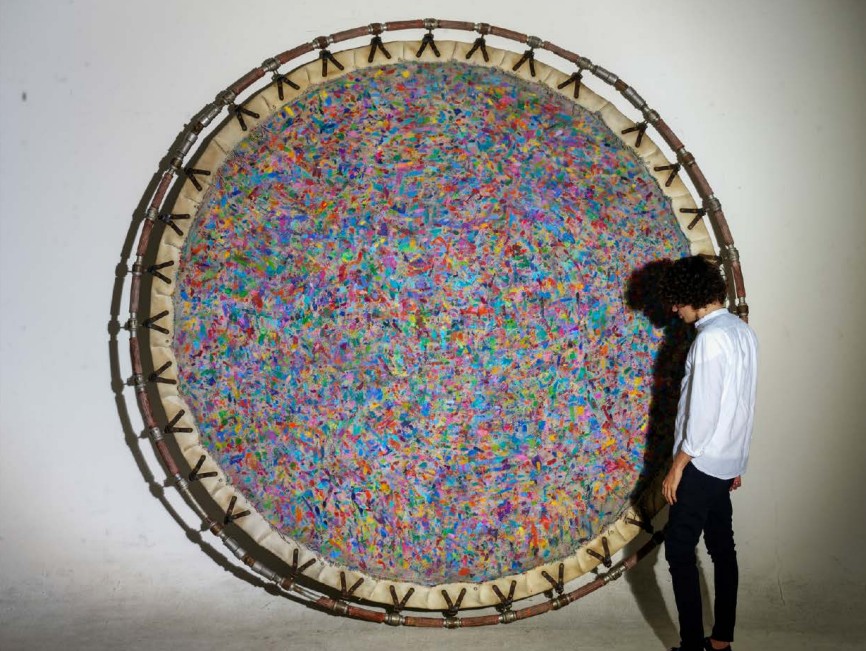
At the heart of the exhibition stands a signature trampoline—once a rehabilitation tool, now transformed into a canvas—symbolizing solidarity and renewal. It invites visitors to see life anew, through the lens of courage. It’s the same trampoline Krissan spotted on a trip to New York, instantly recognizing its metaphorical value in their lives as a safety net they offered Nicholas. “I brought it with me immediately, knowing Nicholas would love to paint it.”
As a tribute to the heroes who once held such safety nets: until the late 1980s, before modern firefighting equipment was widely available, trampolines—also called “life nets”—were used by firefighters to safely catch people jumping from burning buildings. The colors in this artwork are mixed with ash from the fireplace of his family home.
Nicholas never learned to paint traditionally. He didn’t attend formal art classes, didn’t follow the rules of perspective, and didn’t measure symmetry. He learned to paint as he learned to live—with instinct and passion. Most of his hours are spent in the studio of his home, a sanctuary filled with colors and unusual tools: cake spatulas, plaster scrapers, scrub brushes, mops, sticks, even old shoes and rubber tubes, surrounded by the energy of his works.
Sometimes he paints from his chair, other times lying on the floor when his condition worsens. But the art never stops. On the contrary, it breathes through moments of weakness, born through the most unexpected of mediums. His materials go far beyond classic paints—acrylics, oils, gouache, and ink. He also uses spices, ash, coffee, even dirt, allowing the materials themselves to tell stories, evoke memory, texture, scent. His canvases are large, commanding, filled with bold colors and abstract forms that hint rather than describe. He creates densely layered surfaces that demand attention, rich in detail and signs resembling hieroglyphs—symbols that carry secrets.
“His studio, just steps from our home, functions both as a workspace and a refuge, seamlessly blending art with his daily life. As his parents, we imagined our house as a supportive environment tailored to Nicholas’s unique needs. Over time, this space evolved into his art studio—a place where he can comfortably move between painting, family interaction, and rest. This carefully designed environment allows him to work at his own pace, whether painting from a chair or the floor, with direct access to medical support and daily care”, his parents explain.
“For Nick, painting is not just art—it’s therapy, a safe world where he can exist freely. He pushes the boundaries of creation, developing a unique, instructive visual language through his marks. He paints within the circle of love that surrounds him—a circle essential to his very being. His works are colorful, bold, and full of life, yet also reveal a remarkable restraint that showcases his talent. Abstract marks spread across the canvas, drawing the viewer into his world. Hidden within the textures and brushstrokes lie simple, almost ritualistic movements—each brushstroke a healing, pure moment of creation and memory. Nick pours his passion onto the canvas. And his work moves me deeply”, says Arthur Lewis, the exhibition’s curator.
To date, Nicholas Kontaxis has held numerous solo exhibitions worldwide. His direct emotional approach to abstract expressionism has resonated with audiences and received critical acclaim. His work is part of the collections of Beth Rudin DeWoody, Denise Gardner, Eric Schmidt, Jeremy Zimmer, and Roger Federer, among others, and has been commissioned by Kaiser Permanente hospitals and Adidas. Through his inspiring, large-scale canvases, Nicholas has touched countless individuals and institutions worldwide.
“‘Catch Me’ is Nicholas’s dream to share his art with Greece, the country of his ancestors. It is our invitation to the public to join hands and witness how creativity can become refuge, hope, and a way of life. Nicholas may not speak with words, but through his art, he says everything that words so often cannot”, Krissan Kontaxis shares.
The Basil & Elise Goulandris Foundation – A Space of Social Inclusivity
Art has always been a powerful tool for overcoming adversity, whether physical, mental, social, or cultural. From painters like Vincent van Gogh, who found solace in their canvases, to writers like Fyodor Dostoevsky and Gustave Flaubert—both believed to have lived with epilepsy—creativity has served as a means of processing, understanding, and above all, transforming pain. It is a path through difficulty.
“Epilepsy is a condition that dates back to antiquity. It can affect not only the body but also a person’s emotional and cognitive capacities. What it does is shift brain function from normal to ‘abnormal,’ giving rise to pathological phenomena”, explained neurologist Dionysis Pandis during the press conference for the “Catch Me” exhibition. He continued: “History shows us that many individuals with this alternate brain function have been artists who sought to express, through their work, the experiences their condition gave them. This interplay between normal and altered brain activity is both challenging and fascinating for us neuroscientists—it raises interesting questions. Should we perhaps see this difference as part of one’s identity—something worth highlighting in a creative and empowering way? Should individuals with this condition begin to view it as a companion, even a friend? History and art offer countless living examples of this. I hope this exhibition helps illuminate that difference and that Nicholas Kontaxis’s work inspires people with epilepsy and teaches the rest of us something deeper about the potential of the human mind”.
The hosting of this exhibition at the Basil & Elise Goulandris Foundation is deeply significant, reinforcing the museum’s social mission. “When we inaugurated the museum a few years ago, we aimed to create a space of inclusion, harmony, love, art, and social openness”, noted Fleurette Karadonti, President of the Foundation’s Board of Trustees.
“The human soul holds vast reservoirs. The more you dig, the more you feel you are solving one problem and continually moving forward. It is inexhaustible. What I see today in Nicholas Kontaxis’s work reminds me of Fauvism—a movement based on using color freely, without constraints. Nicholas has found a way to transcend his condition,” said Kyriakos Koutsomallis, Director of the Basil & Elise Goulandris Foundation, emphasizing the importance of never giving up—because “there’s always a crack where the light comes in”.